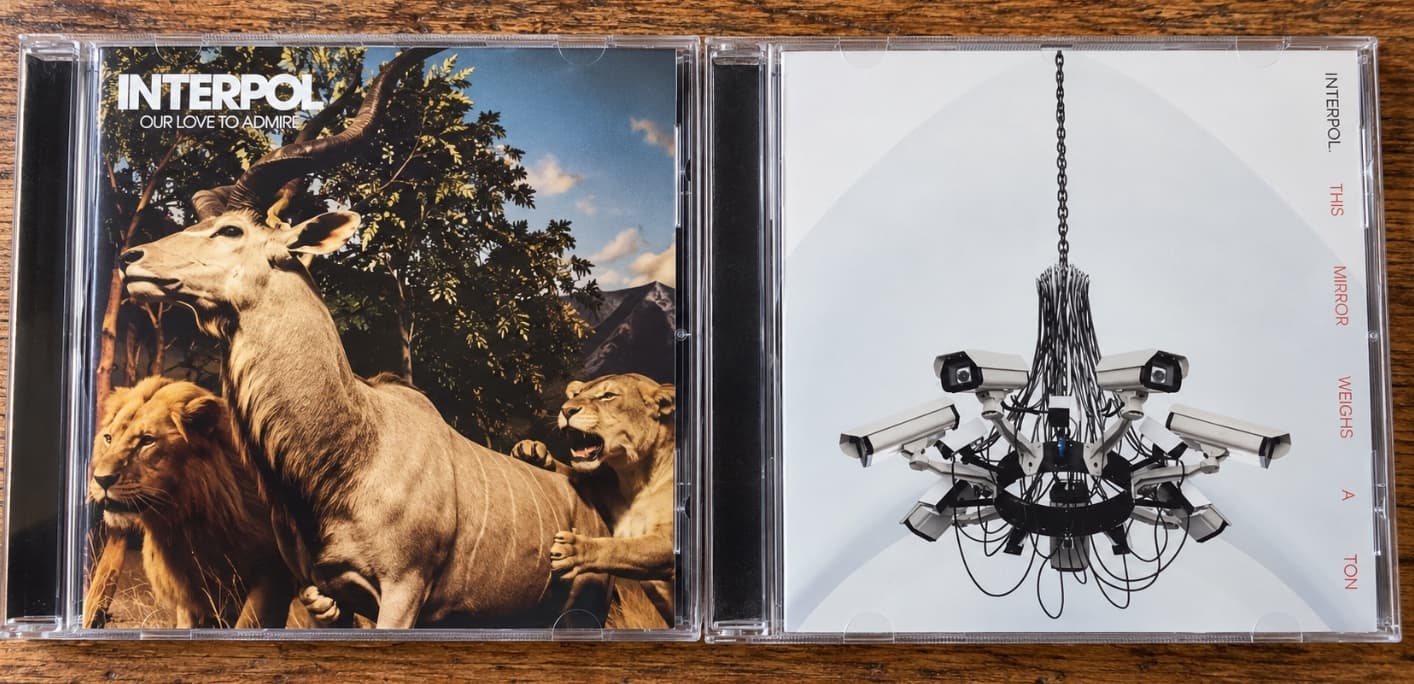
The recent release of Interpol's new album, This Mirror Weighs a Ton, got me thinking about something.
How much do music reviews and critics actually influence what we hear? And can somebody else's opinion quietly plant a doubt in our minds that becomes hard to shake?
I ask because I know it happened to me, I can still recall those cogs cranking over in my head having a bit of friction.
I've been a big Interpol fan since the beginning. I loved the first two albums, Turn On the Bright Lights and Antics, and I'm still a huge fan of the band today.
Then their third album, Our Love to Admire, came out. I purchased the CD as usual and I recall loving it, not as strong as the first two but that level of creativity would be hard to sustain and Interpol have a particular sound so anyway I get it but to me it was great Interpol album.
Then I made the mistake.
I went online and read the reviews.
This was the heyday of the music review website. You'd buy an album, listen to it, then almost instinctively jump online to find out what the critics had decided. Metacritic, Pitchfork, Louder, etc etc
The reviews of Our Love to Admire weren't universally terrible. But I remember enough of them being lukewarm. Words like predictable and mundane. The suggestion of a band starting to go through the motions.
And something strange happened. That's when my mind started having a quiet debate, deep down down somewhere quietly but I could hear it..... I tried to ignore it, pretend it wasn't there but damn it was there
Does this sound a bit repetitive?
Have Interpol already done this before?
Maybe this really isn't as good as I thought it was.
Nothing about the album had changed.
But the way I was listening to it had.
I still loved Interpol. I still liked the album. But somehow the reviewers had handed my brain a new vocabulary for what I was hearing.
So why did I recall this
Well the new Interpol album just dropped, This Mirror Weighs a Ton, on 28 August, their first studio album since 2022.
And I like it, it's not immediately likeable and that's what I love, that means it will have longevity. Usually for me it means I'll discover different songs over time and I will enjoy the album over a longer time period.
But funny enough I thought ok wonder what people and the critics are saying about this album
So I opened the chrome browser and started typing and then bang! No! Remember last time... who cares
I closed it.
And kept listening.
Which made me wonder whether there's any actual psychology behind this.
Turns out there is.
Yes, critics can change what we think we hear
One of the most relevant studies I found was by psychologists Kathleen Silva and Francisco Silva.
They had people listen to favourable National Public Radio reviews of albums by Radiohead, Nine Inch Nails, Stephen Malkmus and Sloan.
Other listeners heard the same musical excerpts without the critic's review.
Afterwards, the people who had heard the favourable reviews rated the music more positively.
In other words, the critics weren't simply predicting what the listeners would like.
Hearing the critic changed their judgement.
The researchers concluded that music critics can influence listeners' musical preferences, rather than merely reflect them. (Silva & Silva, 2010)
That reminded me of exactly what happened with that Interpol album.
Someone gives you an idea about what you're about to hear, and your brain starts looking for evidence that they're right.
Same music, different story, different judgement
There's an even stranger experiment called the repeated recording illusion.
Researchers Manuel Anglada-Tort and Daniel Müllensiefen played participants what they were told were different performances of a piece of music.
Except they weren't different.
They were listening to exactly the same recording, over and over.
The only thing that changed was the information they were given about the supposed performer, suggesting different levels of prestige.
Around 75% of participants believed they really had heard different performances, and the information about the performer significantly influenced their ratings.
Same recording.
Different expectation.
Different judgement.
(Anglada-Tort & Müllensiefen, 2017)
That fascinates me, because nobody had changed the music.
They had changed the story surrounding the music.
And apparently that was enough.
Knowing this doesn't make you immune
Another experiment took the idea further.
Gökhan Aydogan and colleagues looked at what happens when people evaluate musical performances after being told something about the status of the performer.
Again, those expectations biased how people judged what they heard.
The researchers also found changes in brain activity associated with valuation. And here's the part that got me. The bias persisted even when listeners were given plenty of time to actually listen and judge the music for themselves.
The people who were better at resisting the framing showed more activity in brain systems associated with cognitive control. Which is a polite way of saying it takes real effort.
So even when the music is sitting right there giving us evidence, our original expectation can hang around.
(Aydogan et al., 2018)
That comes pretty close to the thing I was wondering about.
Once someone says "this album is boring", you notice the boring bits.
"They've run out of ideas." Suddenly something familiar sounds recycled.
"This is their masterpiece." Now perhaps that strange song you'd normally skip deserves another five listens, because maybe you just haven't understood it yet.
The reviewer hasn't physically changed the record.
But they may have changed the frame you experience it through.
And then there's everybody else
It isn't only professional critics.
In one of the most famous experiments involving music and social influence, researchers Matthew Salganik, Peter Dodds and Duncan Watts built an artificial online music market.
More than 14,000 people listened to songs by unknown bands.
Some people chose songs without knowing what anybody else was doing.
Others could see which songs were supposedly popular.
Once people could see what everyone else was choosing, popularity itself started driving the choices. Success became more unequal and less predictable.
In other words, people liking something helped make other people like it too. Or at least choose it.
(Salganik, Dodds & Watts, 2006)
A follow-up experiment went further and deliberately showed people false popularity rankings.
Many of those false signals turned into reality. Songs presented as popular attracted more attention and more downloads.
The researchers called it a self-fulfilling prophecy. (Salganik & Watts, 2008)
Which makes star ratings, review scores, streaming numbers and Album of the Year lists feel slightly less innocent.
So should we stop reading music reviews?
No.
I love good music writing.
A great critic can introduce you to something you'd never have found. They can explain things about an album you completely missed. They can send you back to a record and make you hear it differently.
Sometimes that's fantastic.
But I have a new rule.
Listen first. Read later.
Especially if it's a band I already love.
Let the album live with me for a while.
Play it in the car.
Play it too loud.
Skip a song.
Come back to it.
Discover that the track I didn't care about on the first listen has somehow become my favourite three weeks later.
The reviews will still be there next week.
Has this ever happened to you?
Have you loved an album, read a bad review, and then suddenly started hearing everything the reviewer criticised?
Or the opposite. Have you ever wondered whether you learned to love a supposedly classic album partly because everyone kept telling you it was a masterpiece?
I'd genuinely love to know. Tell me on Instagram.
Research mentioned
- Silva, K.M. & Silva, F.J. (2010). National Public Radio Music Critics Have the Power of Persuasion. Media Psychology Review. Read it here.
- Anglada-Tort, M. & Müllensiefen, D. (2017). The Repeated Recording Illusion: The Effects of Extrinsic and Individual Difference Factors on Musical Judgments. Music Perception, 35(1), 94-117. DOI 10.1525/mp.2017.35.1.94.
- Aydogan, G. et al. (2018). Overcoming Bias: Cognitive Control Reduces Susceptibility to Framing Effects in Evaluating Musical Performance. Scientific Reports, 8, 6229. DOI 10.1038/s41598-018-24528-3.
- Salganik, M.J., Dodds, P.S. & Watts, D.J. (2006). Experimental Study of Inequality and Unpredictability in an Artificial Cultural Market. Science, 311, 854-856. DOI 10.1126/science.1121066.
- Salganik, M.J. & Watts, D.J. (2008). Leading the Herd Astray: An Experimental Study of Self-Fulfilling Prophecies in an Artificial Cultural Market. Social Psychology Quarterly, 71(4), 338-355. DOI 10.1177/019027250807100404.